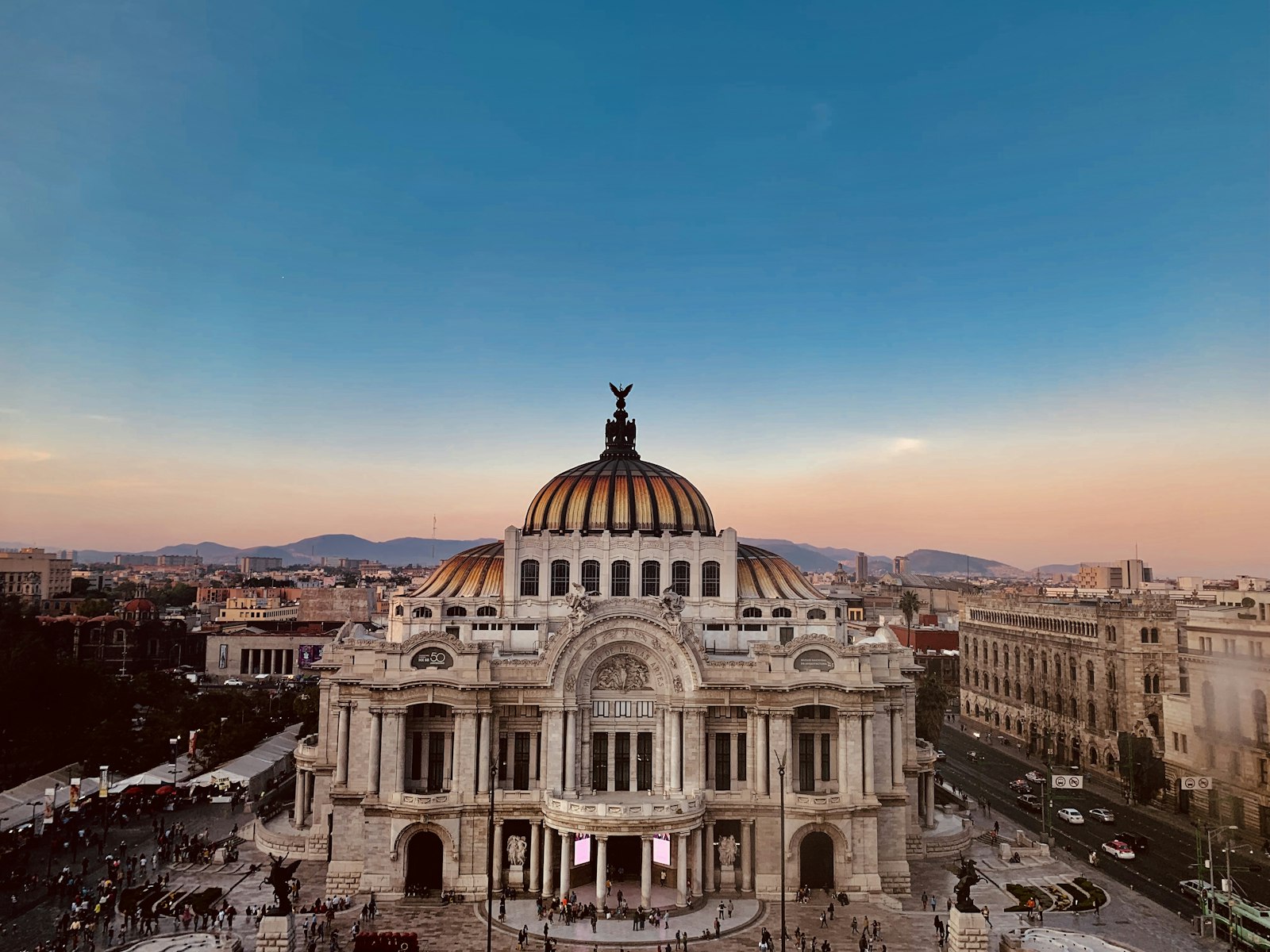
November through April is Mexico City's dry season, and it is the best winter city break in the Americas. Afternoons sit around 70–75°F under hard blue skies, the rain that defines the summer months stops almost entirely, and the smog that the city's reputation still rests on has improved beyond recognition. It is four hours from Dallas and five from New York, it holds more museums than any city in the hemisphere, and a serious five-star room runs $316 a night. The only real cost is altitude, and it is manageable if you plan the first day around it.
Why Winter, Specifically
Mexico City sits at 7,350 feet, which does most of the work on the climate: it is temperate year-round rather than tropical, and the variable is rain, not heat. From June through September the afternoons break into hard daily storms — spectacular from a rooftop, ruinous for a walking itinerary. From November the sky clears and stays clear, mornings run cool enough for a jacket and afternoons settle in the low 70s. December through February are the driest months of all. By late March the jacarandas come out and the whole city turns purple for three weeks, which is the single most beautiful thing that happens here and the reason to consider late-season dates.
Is the Altitude a Problem?
For most people, mildly, for about a day. At 7,350 feet — higher than Denver — the first evening tends to bring shortness of breath on stairs, a light headache, and alcohol that hits noticeably harder. The fix is unglamorous and effective: drink more water than feels necessary, skip the gym on day one, and plan a flat first afternoon rather than the Teotihuacán pyramids. Do not treat it as trivial if you are coming from sea level with a cardiac or respiratory condition — the effect is real. By the second morning almost everyone is fine, and by the third the altitude only shows up in how quickly a mezcal works.
Where Should You Actually Stay?
Three neighbourhoods are worth your time, and they are different trips. Polanco is the luxury quarter — embassies, Avenida Presidente Masaryk, the best restaurants, and walking distance to Chapultepec. Presidente InterContinental Mexico City anchors it, with six restaurants and views over the park, and at roughly $316 a night in November it is the outstanding value in the city. Hyatt Regency Mexico City is two minutes away on Campos Elíseos, nearer $1,369 in the same week — a reminder to price your specific dates rather than the neighbourhood. Reforma puts you on the grand avenue between the historic centre and Polanco: Sofitel Mexico City Reforma stands beside the Angel of Independence with the best rooftop view of the boulevard, and Barceló Mexico Reforma sits at the other end near the Alameda. Roma and Condesa — leafy, low-rise, Art Deco, and where you will actually want to eat dinner — have almost no five-star inventory, which is an argument for staying in Polanco and taking the fifteen-minute ride.
The Museums Are the Point
The Museo Nacional de Antropología is not a good museum by Latin American standards; it is one of the two or three great museums anywhere, and the Aztec and Maya halls alone justify a long morning. The Museo Frida Kahlo in Coyoacán sells out days ahead in winter and must be booked online before you fly. The Museo Jumex and the Museo Soumaya stand next to each other in Polanco and can be done in an afternoon. What ties them together is that the city treats its own history as unfinished business — the Templo Mayor ruins sit exposed beside the cathedral in the Zócalo, excavated after 1978 when electrical workers hit a stone disc, and you can stand on a walkway above Aztec foundations with a colonial baroque facade at your shoulder.
Eating in Mexico City
This is among the best food cities in the world and the range is the point. At the top, Pujol and Quintonil both sit in the global top fifty and need reservations six to eight weeks ahead; Rosetta, in a Roma townhouse, is the one locals send you to first. In the middle, Contramar at lunch is a genuine institution — the tuna tostadas and the pescado a la talla, and a two-hour table that runs until four. At the bottom, which is where the actual eating happens, El Turix in Polanco does cochinita pibil out of a counter the size of a hallway, and the taquerías of Roma Norte after midnight are the reason people move here. Our San Sebastián food guide makes the same argument about a different city: the Michelin restaurants are worth booking, and they are not why you came.
Getting There and Getting Around
Benito Juárez International (MEX) is served nonstop from most large US cities — four hours from Dallas or Houston, five from New York, four and a half from Los Angeles — which makes a long weekend genuinely viable in a way that no other city of this calibre is. Uber is cheap, ubiquitous and the default; the Metro is faster at rush hour and costs five pesos. Do not rent a car. For day trips, Teotihuacán is an hour north and best at opening time, and Puebla is two hours east and worth an overnight if you have five days.
What It Costs
A fraction of the equivalent elsewhere. The Presidente InterContinental runs about $316 a night in mid-November and $351 in mid-January, which is what a mid-tier airport hotel costs in western Europe. The spread across the city is wide — the Sofitel sits near $745 in November and $586 in January, the Hyatt at $1,369 in the same November week — so the two-window check is worth doing here more than almost anywhere. A tasting menu at the top tier runs $150–200 per person, a great lunch at Contramar half that, and the best meal of your trip will probably cost eight dollars. Budget properly for museums and a guide at Teotihuacán, then let the food budget run. When your dates are set, check live Mexico City availability — the week between Christmas and New Year is the only genuinely tight stretch.
Frequently Asked Questions
What is the best time to visit Mexico City?
November through April, the dry season. December to February are the clearest and coolest; late March brings the jacaranda bloom. Avoid June through September unless you are content to plan around a hard storm most afternoons.
Is Mexico City safe for visitors?
The tourist neighbourhoods — Polanco, Roma, Condesa, Coyoacán and the historic centre — are routinely walked by visitors day and night, and ordinary city precautions apply: use Uber rather than street taxis, keep your phone put away on the Metro at rush hour, and do not wander unfamiliar areas late. Check your government's current travel advice for the state-by-state picture before booking.
How many days do you need in Mexico City?
Four full days as a minimum and five if you want a day trip. Two days cover the historic centre and Chapultepec, one covers Coyoacán and Frida Kahlo, one is for Roma and Condesa at their own pace, and the fifth buys Teotihuacán or Puebla.
Do you need to book restaurants in advance?
For the top tier, yes — Pujol and Quintonil take reservations six to eight weeks out and fill. Rosetta needs a couple of weeks. Contramar does not take bookings for lunch, so arrive at one o'clock or wait. Everything else you can walk into.
Is Mexico City expensive?
No, and it is the most underpriced luxury city in the Americas. Five-star rooms start near $316 a night in the high season, world-ranked tasting menus run $150–200 per person, and Uber crosses the city for a few dollars. The flight is usually the largest line item in the trip.